
Commercial Epoxy Flooring Contractor in Phoenix, AZ
Why Commercial Floors in Phoenix Fail Faster Than You Expect
Four Conditions That Destroy the Wrong Floor Product
- Phoenix businesses face floor conditions that most standard commercial coatings are not designed to handle. Here are the four most common failure causes we see on Phoenix commercial slabs.
- Extreme Indoor Heat Non-climate-controlled warehouses and distribution centers in Phoenix can reach internal temperatures above 120 degrees in summer. That heat pushes into the concrete slab and creates stress on the coating bond. Standard epoxy applied without a vapor barrier primer expands under that heat and begins to delaminate from the slab within one to two seasons.
- Thermal Shock in Kitchen Environments Commercial kitchens go through a cycle of extreme heat during cooking and cold water during washdowns. This repeated thermal shock cracks standard epoxy at the molecular bond level. Once the first crack forms, moisture and bacteria enter and the failure spreads fast.
- Chemical Spills and Cleaning Agents Auto shops, manufacturing plants, and food service facilities use strong solvents, degreasers, and cleaning chemicals every day. Most standard epoxy coatings are not chemical-resistant at an industrial level. The chemicals eat through the topcoat and reach the concrete slab below. Once the concrete is contaminated, the coating cannot rebond.
- Moisture Vapor from the Slab Many older commercial buildings in Phoenix, particularly in the Downtown corridor, Tempe, and Mesa, were built without a proper sub-slab vapor barrier. Moisture migrates upward through the concrete and pushes against the coating from the inside. The result is blistering and peeling that starts within weeks of installation and gets worse every monsoon season.
Our Commercial Epoxy Services
Four Floor Systems for Four Different Business Environments
Commercial Flooring Installation
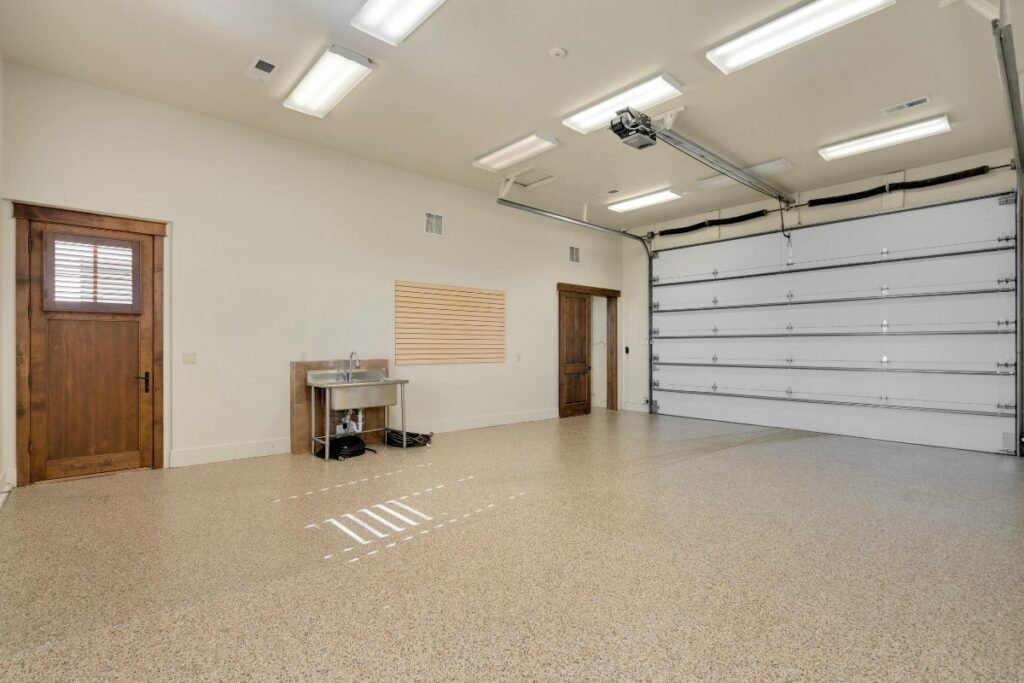
Commercial flooring installation covers large-scale epoxy and polyaspartic coating projects for warehouses, distribution centers, aviation hangars, auto dealerships, and retail spaces across the Phoenix metro area. Large commercial spaces have different needs than small residential jobs. The floor areas are bigger, the traffic is heavier, and the downtime a business can afford is very limited. Closing a warehouse or showroom for three days to coat a floor is not realistic for most Phoenix businesses. We plan every commercial flooring installation around your schedule. We work after hours, on weekends, and in phases so your operation keeps running. In many cases, we can complete a full warehouse floor section and have it back in service within 24 hours using fast-cure polyurea and polyaspartic topcoat systems. Also, we include OSHA-compliant safety aisle striping and floor markings as part of large warehouse floor projects. This covers forklift lanes, pedestrian walkways, loading zone markings, and safety zone boundaries. These are required by OSHA for most Phoenix industrial facilities and help businesses avoid compliance violations before an audit. We serve commercial flooring clients in Mesa, Chandler, Goodyear, Surprise, Glendale, and across the Phoenix industrial corridor.
Slip Resistant Coatings
Slip-resistant coatings protect your business from two things at once: workplace injuries and liability claims. A wet commercial floor in a Phoenix restaurant, warehouse, or medical facility is a real hazard. A worker or customer who slips and falls on your property can result in a workers compensation claim, an OSHA citation, or a personal injury lawsuit. In Arizona, these cases are not uncommon, especially in food service and industrial environments. Our slip-resistant coatings add a textured surface to any epoxy, polyaspartic, or urethane cement floor. We use several types of texture additives depending on the environment. For dry commercial spaces like retail floors and office lobbies, we use a fine aluminum oxide aggregate that adds grip without changing the clean look of the floor. For wet commercial kitchens and loading docks, we use a heavier broadcast aggregate that provides maximum traction even when the surface is wet with grease, water, or cleaning solution. Also, our slip-resistant finishes are OSHA-compliant. We follow the OSHA standard 1910.22(a)(2) for walking-working surfaces and can provide a written compliance statement for your records after the job is complete. We install slip-resistant commercial coatings for restaurants, schools, hospitals, warehouses, and retail locations in Phoenix, Tempe, Mesa, Peoria, Glendale, and Scottsdale.
Industrial Urethane Cement
Industrial urethane cement is the highest-performance floor system we install. It is built for environments that would destroy standard epoxy within months. Here is the difference. Epoxy bonds well to concrete and handles moderate chemical exposure and foot traffic. Industrial urethane cement goes further. It handles extreme impact loads, forklift traffic, chemical exposure, and temperature swings that break other coatings apart. Phoenix has a growing number of food processing facilities, pharmaceutical plants, brewery operations, and manufacturing plants in the Chandler, Mesa, Gilbert, and Surprise industrial zones. These facilities need a floor that can hold up under industrial-grade equipment and still pass strict FDA, USDA, or ISO inspection standards. Urethane cement meets those requirements when installed using a manufacturer-certified food-grade system. Not all urethane cement products carry FDA or USDA certification. We use certified food-grade urethane cement systems specifically approved for direct and incidental food contact environments. It creates a seamless, antimicrobial surface that resists acids, solvents, cleaning chemicals, and steam pressure. It handles temperature extremes from below freezing cold storage areas to high-heat production zones without cracking. Also, urethane cement cures to a slip-resistant texture by default. This reduces the need for separate anti-slip additives in most industrial applications. If your facility has ever had an epoxy floor fail, crack, or bubble within the first two years, industrial urethane cement is likely the right product for your slab and your environment. We install industrial urethane cement for manufacturing and food processing clients in Mesa, Chandler, Gilbert, Goodyear, and the broader Phoenix industrial corridor.
Commercial Kitchen Epoxy Flooring
Commercial kitchen epoxy flooring is a specialized floor system for restaurants, catering facilities, food processing plants, breweries, and hotel kitchens across Phoenix, AZ.
A standard epoxy floor will not work in a commercial kitchen. Here is why. Commercial kitchens get blasted with hot water during washdowns. That sudden switch from hot to cold is called thermal shock. Standard epoxy cracks and peels under repeated thermal shock because it cannot flex fast enough to keep up with the temperature change.
We use a thermal shock-resistant urethane cement base in every commercial kitchen installation. This material flexes with the concrete when the temperature shifts. The surface stays intact through years of daily hot washdowns.
Also, commercial kitchens in Phoenix must pass Maricopa County health inspections. Health inspectors look for a seamless, non-porous floor that has no gaps where grease, bacteria, or food particles can collect. Our commercial kitchen epoxy system creates a fully seamless surface from floor to wall using coved base molding. The floor curves up the wall at every edge, removing the joint where most kitchens collect bacteria.
This is what health inspectors want to see. It is also what keeps your kitchen staff safe on a wet, busy floor during a full dinner service.
We serve restaurant and food service clients in Tempe, Scottsdale, Arcadia, Gilbert, Chandler, and across the Downtown Phoenix dining corridor.